A diesel fuel system cannot run dry without risking air ingestion into the injection system, which requires bleeding and can strand the car. Any range calculation must account for a 3-gallon minimum reserve. Stowell's 40-gallon system therefore yields roughly 851 usable miles per fill (37 × 23 mpg), consistent with the reported 800–900 mile range figures.
At that range, 2,803 miles requires 3.29 segments minimum — which means three fuel stops was the floor for his configuration, not a choice.
The 2-stop threshold requires 45 gallons of total capacity: each of three segments demands 934 miles of range, which at 23 mpg consumes 40.6 gallons, plus the 3-gallon reserve brings the requirement to approximately 44 gallons, rounded to 45 for practical tank sizing.
The delta from Stowell's build is 5 gallons — equivalent to a 29-gallon auxiliary cell versus his 24-gallon cell. That's it. Five gallons buys you an entire fuel stop.
| SCENARIO | TANK | STOPS | FUEL TIME | DRIVE | TOTAL | AVG |
|---|---|---|---|---|---|---|
| Stowell 2024 (Garmin) | 40 gal | 3 | 17:49 | 26:43 | 27:16 | 103 |
| 2-stop tank build | 45 gal | 2 | ~11 min | 26:59 | 27:10 | 103.2 |
Stowell's 29-gallon rated cell yields ~24 gallons usable after foam displacement. Crossing the 2-stop threshold requires a 32-gallon rated cell (~27 gallons usable), bringing total capacity to ~43 gallons — enough to clear 2,803 miles in three segments with reserve.
The stock BMW 535d carries 15.8 gallons in its factory tank, which at Stowell's observed 23 mpg cruise average would provide approximately 360 miles of range before the fuel light appeared. Stowell's build added an aftermarket trunk-mounted fuel cell — likely a 29-gallon rated cell — that brought total capacity to roughly 40 gallons usable, extending theoretical range to over 900 miles per fill.
The auxiliary cell uses reticulated polyurethane foam to control fuel slosh under hard braking and acceleration, a standard motorsport practice borrowed from endurance racing. The foam prevents fuel from sloshing away from the pickup under g-loads that would otherwise cause fuel starvation in a half-empty tank.
Foam displacement is significant: a 29-gallon rated cell with full foam baffling yields approximately 24–25 gallons of usable capacity. Jaz does not make a 24-gallon cell — their sizes jump from 22 to 32 — which suggests Stowell's auxiliary is a 29-gallon cell from Fuel Safe or similar, with the foam accounting for the ~5-gallon difference between rated and usable volume.
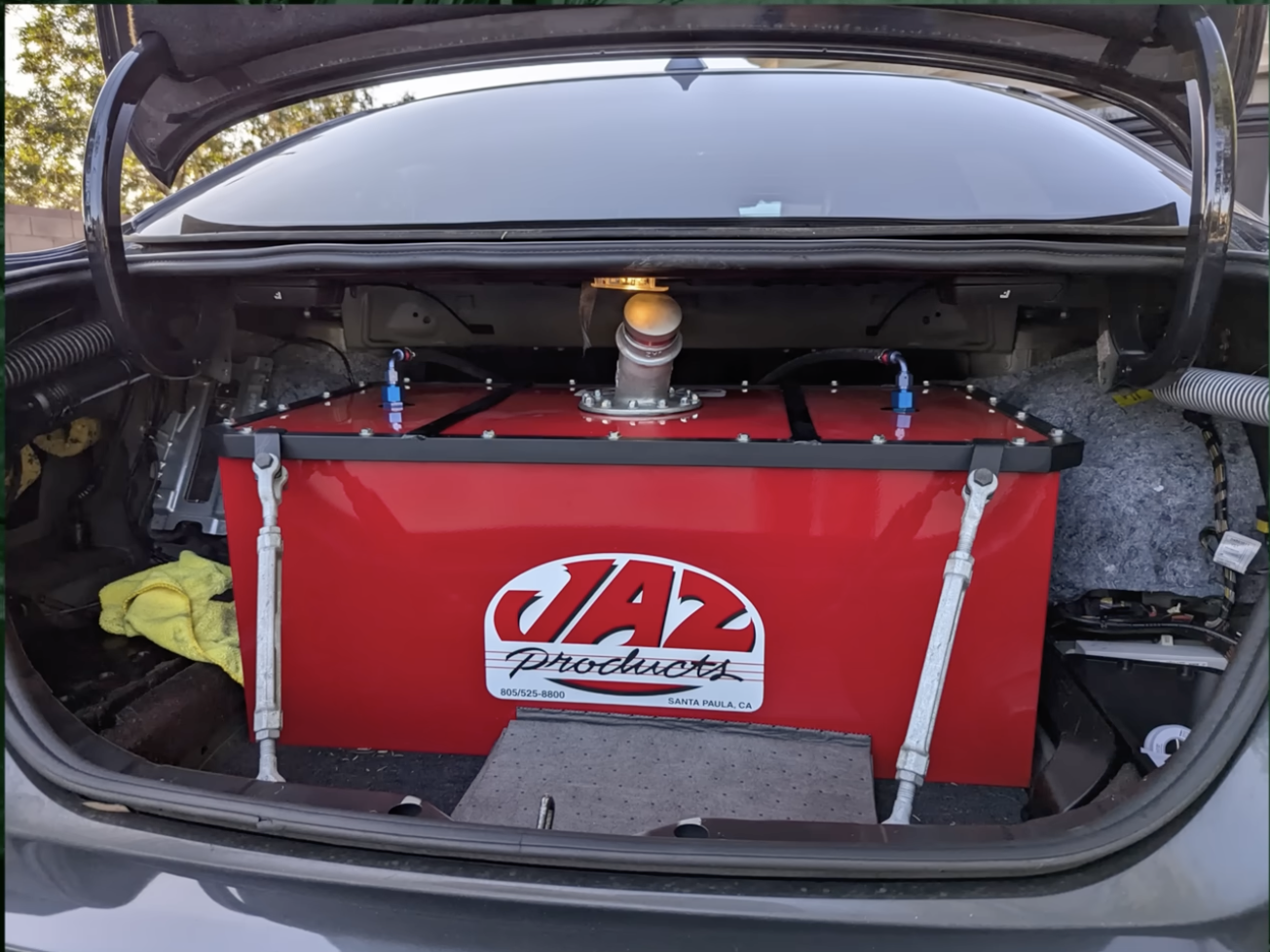
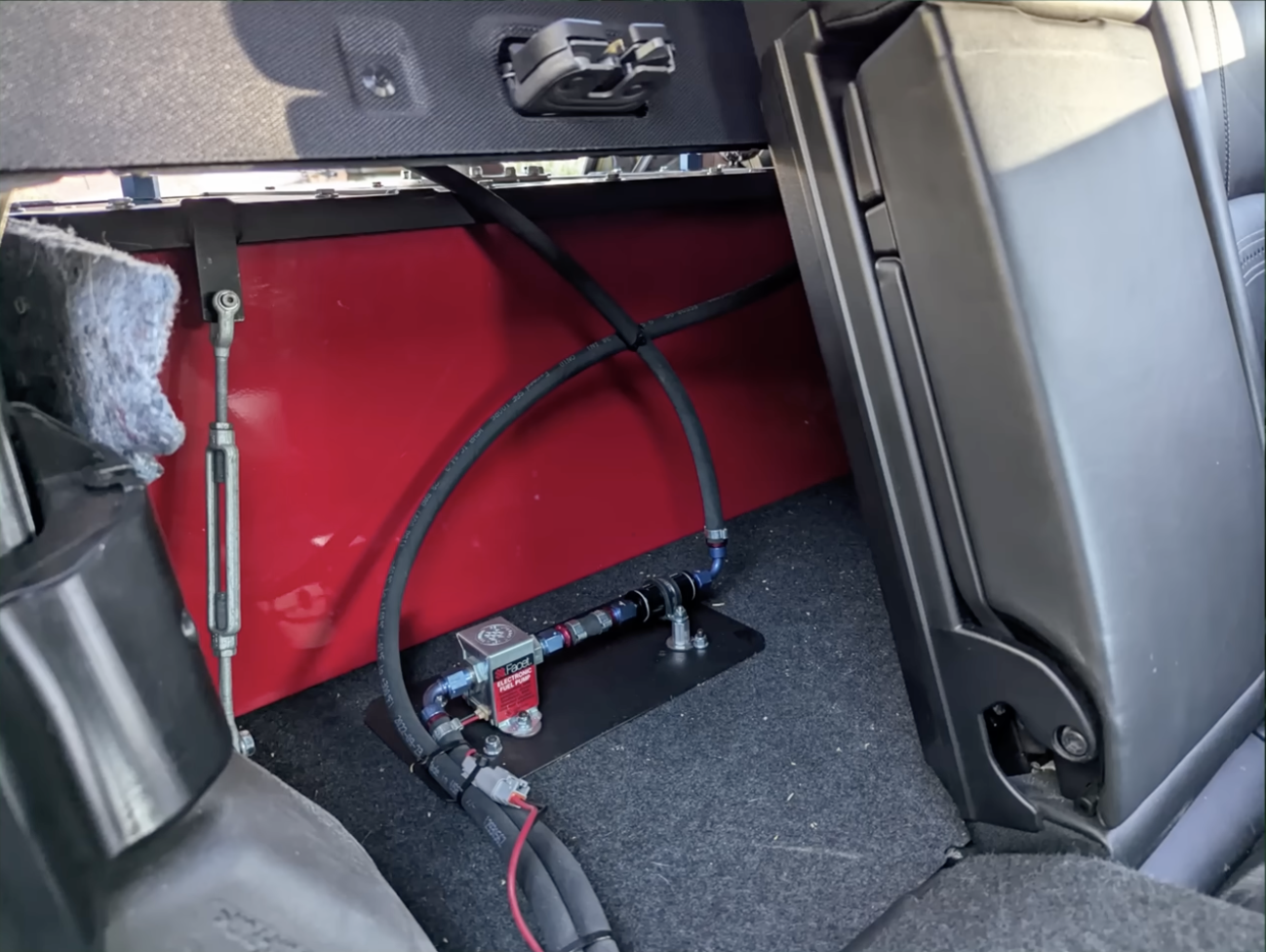
Stowell's 29-gallon rated auxiliary cell with reticulated foam baffling (~24 gal usable)
If Stowell's 29-gallon rated cell yields ~24 gallons usable, the next step up is a 32-gallon rated cell. With the same ~17% foam displacement, a 32-gallon cell would yield approximately 26–27 usable gallons, bringing total capacity to ~42–43 gallons — enough to clear the 2-stop threshold with the 3-gallon reserve factored in.
The physical delta from 29 to 32 gallons is modest. The Jaz 32-gallon Pro Sport (280-032-06) measures 34" × 17⅜" × 14⅜" — a long/narrow form factor that could fit the 535d trunk better than a square cell. Stowell's 29-gallon cell already consumes most of the trunk floor; the 32 is only ~3 inches taller.
Aluminum container, foam, FIA-FT3
24.25" × 24.25" × 12.75"
Aluminum container, foam, FIA-FT3
Steel container, foam, non-FIA
Premium line, FIA-FT3
25⅝" × 25⅝" × 9¼"
Steel can, foam, SFI 28.1
34½" × 18¾" × 10½"
Long/narrow form factor
34" × 17⅜" × 14⅜"
Steel can, foam, SFI 28.1
26⅝" × 18⅝" × 18⅝"
Compact/tall form factor
Jaz sizes jump from 22 to 32 — no 24 or 29. This is consistent with Stowell using a 29-gallon cell from another vendor (likely Fuel Safe). The Jaz 32-gallon is the natural upgrade path: at ~$1,100, it's cheaper than Fuel Safe's 29-gallon Sportsman and yields more usable capacity after foam displacement.
The auxiliary cell must feed the factory tank via a transfer pump, since the BMW's high-pressure diesel injection system draws from the stock tank's in-tank pump. This is standard practice for trunk-cell builds — the aux cell gravity-feeds or pump-feeds the factory tank to keep it topped off. Stowell's build already solved this plumbing problem; the only change for a 32-gallon cell is a larger physical container in the same location.
Weight penalty is real but manageable. Three additional usable gallons of diesel weighs approximately 21 lbs. At 103 mph average, the fuel economy impact in a 4,200-lb car is negligible.
The reticulated foam baffling is non-negotiable and already accounts for the capacity difference between rated and usable volume. Without it, 200+ lbs of liquid diesel sloshing under braking creates a safety hazard and can cause fuel starvation at the pickup. Both Fuel Safe and Jaz include foam as standard equipment in their motorsport cells.
Carl Reese and Deena Mastracci set the previous diesel record at 29:49 in an Audi A8 TDI. The A8's factory 23.7-gallon tank gives it more stock range than the 535d, and the 3.0L TDI V6 delivers similar highway fuel economy. Their build also used an auxiliary fuel system to extend range.
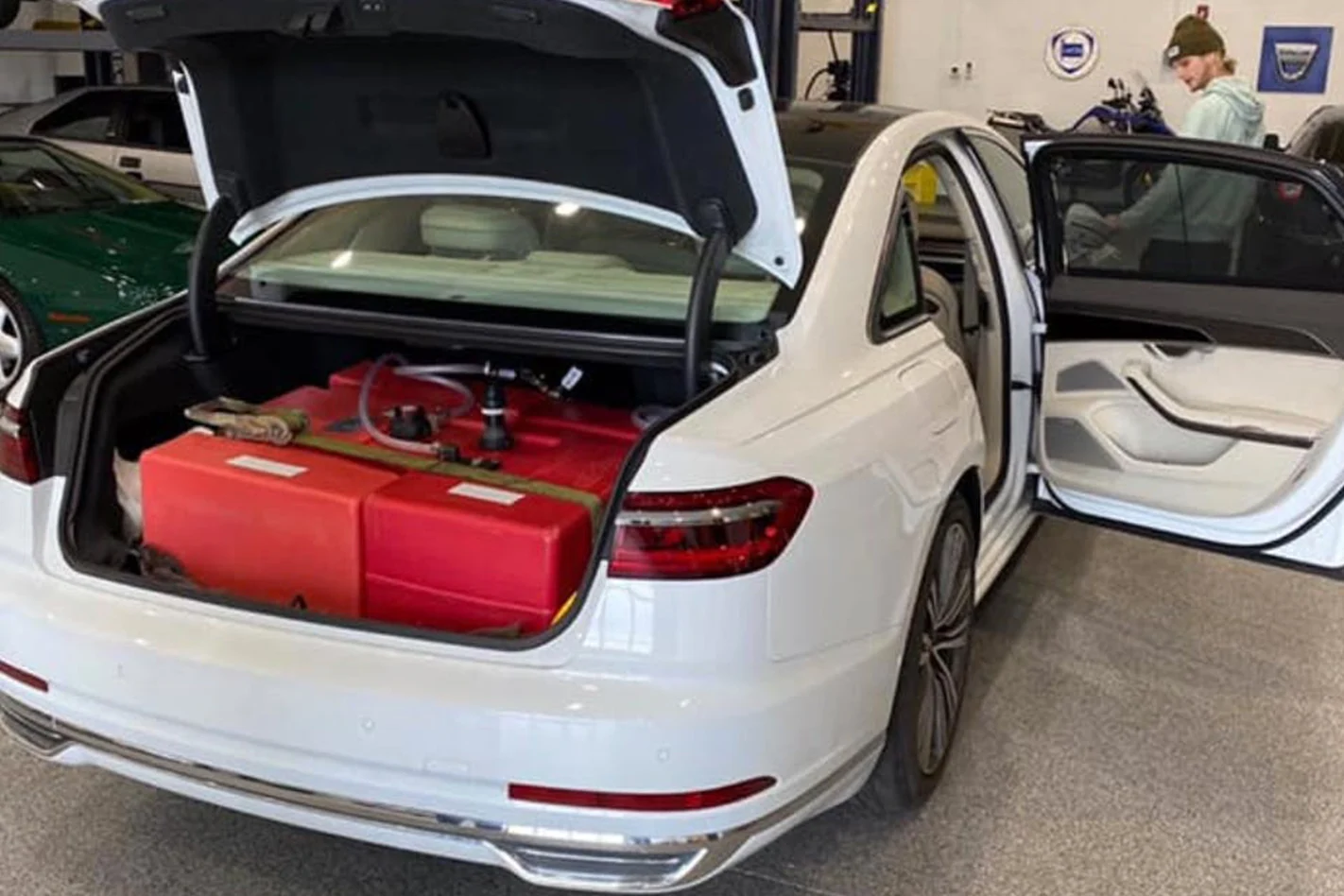
Audi A8 TDI fuel system — Carl Reese & Deena Mastracci