Everyone Is Trying to Hide
Every competitive Cannonball car since 2006 has been some variation of the same formula: fast German sedan, dark paint, auxiliary fuel cell, countermeasures. Mercedes CL55. Audi S6. BMW M5. The formula works. But increasingly, these teams are spending as much effort on disguise as on speed.
Ed Bolian's 2013 record CL55 AMG was fitted with a kill switch for the rear lights — go dark at night and disappear. The car was chosen specifically because most people don't know what a CL-Class is. It's a sleeper by obscurity.
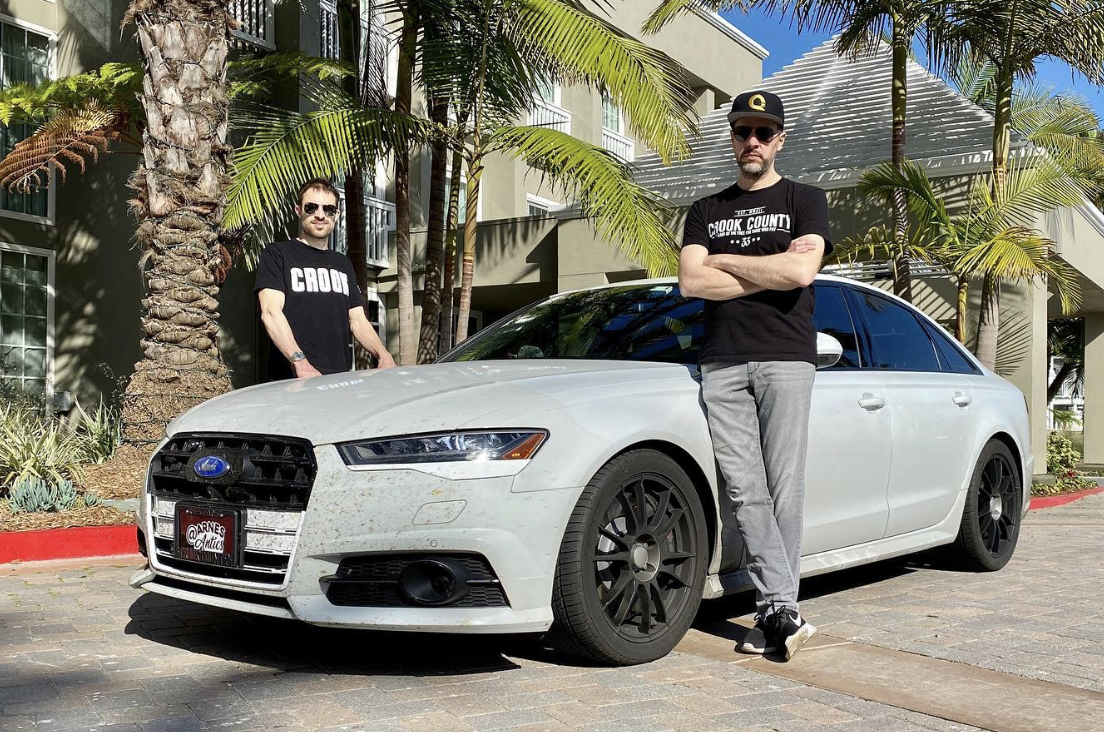
Arne Toman took it further. His record-setting Audi S6 was deliberately disguised to look like a Ford Taurus — the same platform used by police departments as the Interceptor Sedan. He altered the headlights and taillights, removed all Audi badging, and fabricated a fake emblem for the grille. At a glance, especially at night, it read as a police car.
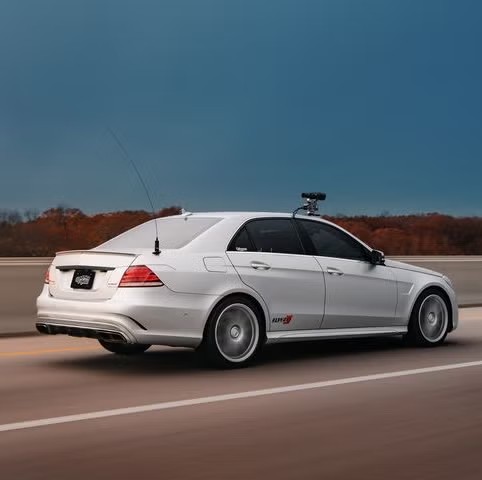
And then there's the equipment. When this E63 AMG ran coast-to-coast, it carried a roof-mounted thermal scope and whip antenna. Effective hardware — but on a white Mercedes sedan at highway speed, it looks like exactly what it is: something that shouldn't be there. The system was pulled down during the day to look less conspicuous.
The pattern is clear. Every serious team is moving in the same direction: look like law enforcement. But they're doing it by modifying civilian cars to approximate the look. What if you just started with the real thing?
To Look Like a Cop, Drive a Cop Car
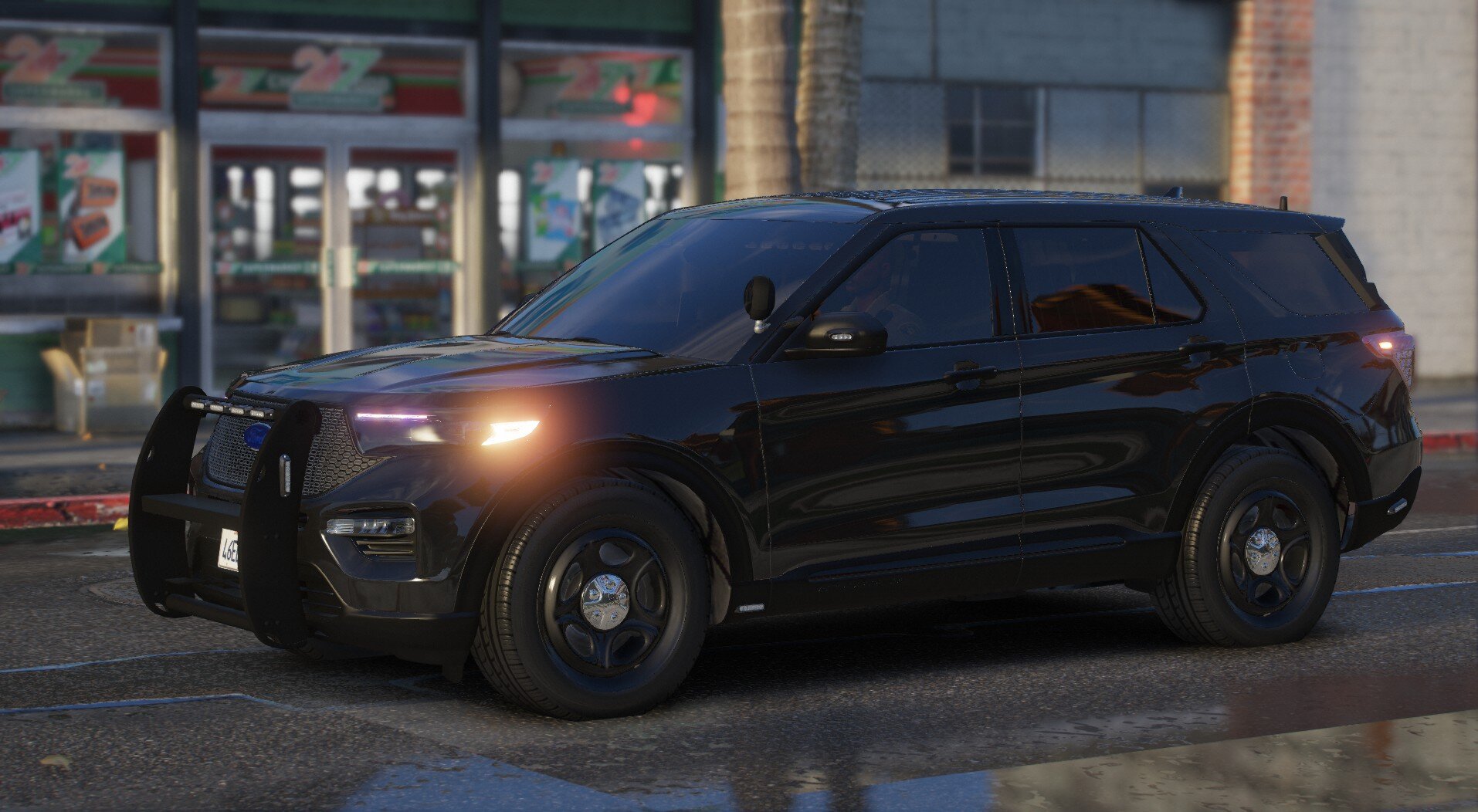
The Ford Explorer Police Interceptor Utility is the most common law enforcement vehicle in America. State police, sheriffs, highway patrol, federal agencies — Explorers are everywhere. Every driver in the country has seen one in their rearview mirror.
When a civilian gets passed by a marked or unmarked Explorer on the highway, they don't love it — but they don't call it in. It's just another cop going somewhere. No alarm. No 911. No "there's a car doing 140 on I-70." It's just the world working as expected.
Now think about the equipment that recent Cannonball cars have carried. Roy's thermal camera and whip antennas. Toman's police-silhouette disguise. Scanner arrays, radar detectors mounted on windshields. On a blacked-out German sedan, these things look suspicious. On an Explorer with a push bar? They look like they belong.
A roof-mounted thermal scope and whip antenna don't look out of place on an Explorer. Neither does a spotlight, a scanner antenna, or a bull bar. Every piece of equipment that a Cannonball car needs to carry is equipment that a police vehicle already carries. The Explorer doesn't need to be disguised. It already looks the part.
Ford Explorer Police Interceptor Utility
The 3.0L EcoBoost twin-turbo V6 puts out 400 hp and 415 lb-ft of torque through a 10-speed automatic and full-time intelligent AWD. Top speed is electronically limited to 148 mph. That's not E63 territory — and that's the biggest trade-off — but it's enough to sustain 120–130 mph across the Midwest.
The suspension is factory reinforced for pursuit duty — heavier springs, upgraded shocks, beefier sway bars. These cars are built to absorb potholes at speed and run hard for entire shifts. A sedan needs aftermarket suspension work to handle a cross-country blast at sustained high speed. The Interceptor has it from the factory.
The SUV ride height is an advantage on these runs. Higher vantage point means better forward visibility — you can see brake lights, traffic, and obstacles further ahead. On a 2,800-mile run at sustained speed, seeing problems a few seconds earlier compounds into a real safety and time advantage.
Below the Window Line
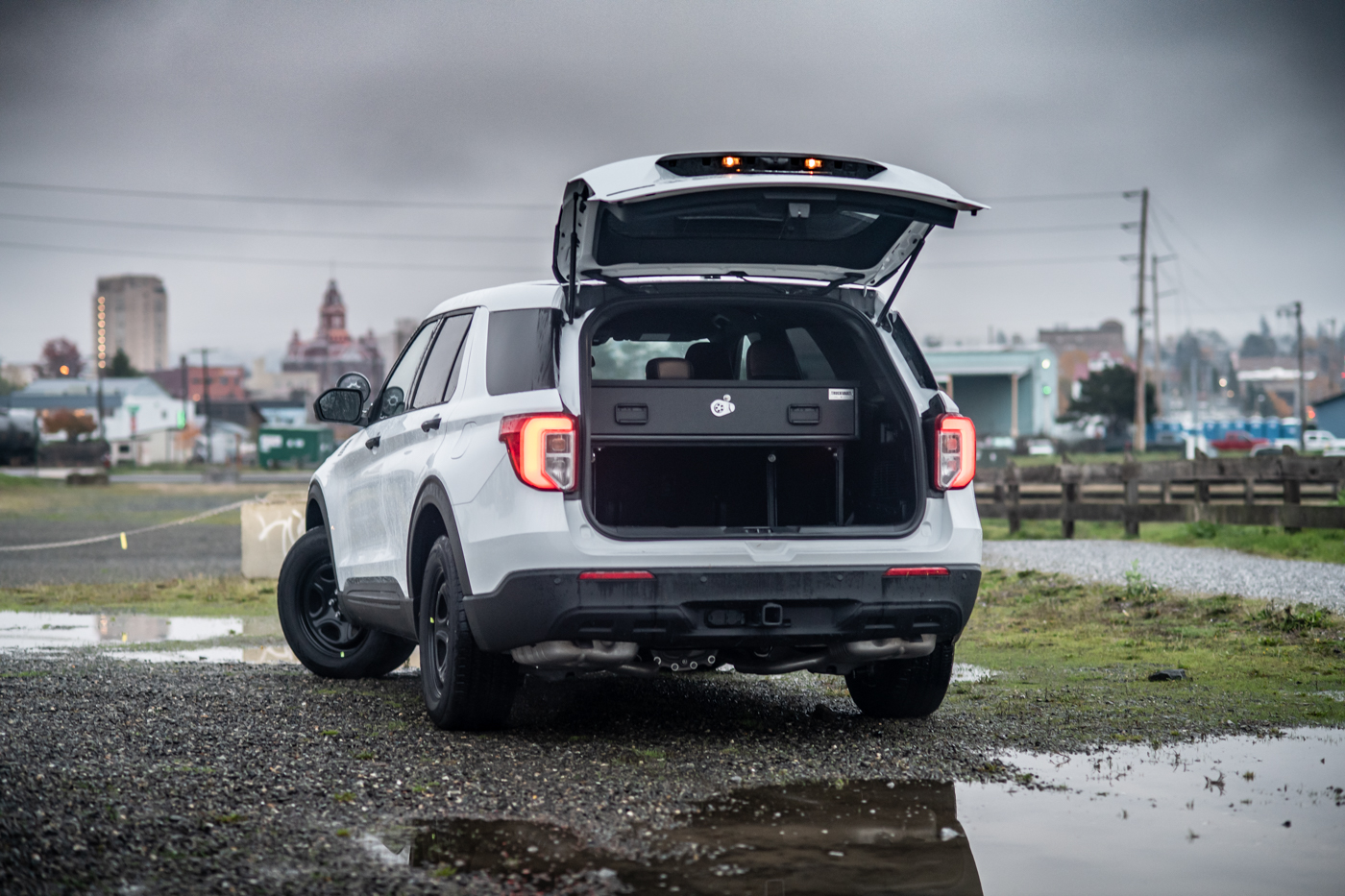
This is where the Explorer changes the equation. The police configuration has a flat cargo floor with roughly 40 × 45 × 20 inches of usable space below the window line. That's 36,000 cubic inches — or about 156 gallons of raw volume.
A custom fuel bladder won't fill every cubic inch of a rectangular space. But even at 75% bladder efficiency, that's ~117 gallons of auxiliary fuel that sits completely hidden below the window. From the outside, the back of the Explorer looks empty. From the inside, it's a rolling gas station.
At 13 mpg sustained highway speed, 138 gallons gives you roughly 1,800 miles of range. New York to LA is 2,803 miles. That's the entire East Coast, the entire Midwest, and into the Rockies on a single fill. One fuel stop. Maybe two.
Compare that to the sedan approach. Toman's Audi S6 carried 87 gallons total — a 45-gallon auxiliary cell crammed into a sedan trunk. Bolian's CL55 had two 22-gallon tanks wedged behind the rear seats for 67 gallons total. The Explorer can carry more fuel than either record car in a space that's below the window, flat on the floor, and invisible from outside.
Fuel capacity is speed strategy. More fuel means you can afford to burn harder. The Explorer gets 12–14 mpg at sustained speed vs. 16–18 for a German sedan. But when you're carrying 138 gallons, the lower fuel economy doesn't matter — you've got the range to compensate, and the extra fuel lets you push sustained speed higher without worrying about running dry between stops. Read the full fuel math breakdown →
Where It Works, Where It Doesn't
Advantages
- Looks like a cop car — other drivers and cops give you space
- Cannonball equipment (thermal, antennas, scanners) looks natural on it
- Massive below-window cargo area for 100+ gallons of hidden auxiliary fuel
- Factory police suspension — built for sustained high-speed punishment
- 400 hp / AWD — capable in weather and all conditions
- Higher ride height improves forward visibility at speed
- $40k used — half the cost of a competitive German sedan
- Common vehicle — blends in at gas stations, rest stops, everywhere
Disadvantages
- 148 mph top speed vs. 175+ for German sedans — the biggest compromise
- 12–14 mpg at speed vs. 16–18 for efficient sedans
- Higher drag coefficient — SUV vs. sedan aerodynamics
- 4,500+ lbs before fuel — heavy vehicle
- Less refined at sustained 130+ mph than purpose-built GT cars
- Cop-car effect is a theory — untested at Cannonball scale
- Risk of actual law enforcement scrutiny if they look too closely
- 10-speed auto lacks the response of a sport transmission
The 148 mph ceiling is real. A blacked-out E63 can hit 175+. On the open stretches of I-40 in New Mexico or I-15 in the Mojave, that 30 mph gap matters. The Explorer thesis only works if the cop-car effect — less braking for enforcement, traffic clearing itself — closes that gap in real-world sustained average speed. Top speed is irrelevant if you're braking every 20 miles. But if you're not braking, 148 is 148.
Why It Probably Doesn't Work
We ran the numbers. Modeled the drag, the fuel burn at speed, the route segment by segment. Without any cop-car effect, the Explorer finishes a simulated coast-to-coast run in 28:06 — essentially identical to a tuned German sedan at 28:01. The Explorer's massive fuel capacity offsets its worse aerodynamics almost perfectly. The physics are a wash.
The problem is the cop-car effect. It sounds good in theory — traffic clears itself, enforcement hesitates — but how much time does that actually save? The record holders aren't getting pulled over anyway. They're using radar detectors, laser jammers, and networks of 30+ spotters to slow down before cops even see them. The Explorer's visual deterrent solves a problem that good countermeasures have already solved.
And the 148 mph ceiling can't be ignored. Bolian hit 158 on I-70 at 6 AM. Toman peaked at 193. On the open stretches where the record is actually won — 1,200 miles of flat, empty Midwest at 3 AM — the Explorer is leaving 30+ mph on the table. That gap compounds across hundreds of miles.
The real lesson is what actually broke the record. In August 2024, Chris Stowell beat Toman's 27:25 with a 27:16 in a BMW 535d — a diesel. Solo. No 30-person spotter network. No 600hp tune. Just a grey 5-series that gets 23 mpg at cruise, nobody looks twice at, and needed barely any auxiliary fuel. The win wasn't the car. It was being invisible in the right conditions.
The Explorer thesis gets the philosophy right: the record goes to the car nobody notices, not the car with the highest top speed. But the execution is wrong. You don't need a cop car to be invisible. You need a boring car. A grey diesel sedan is more invisible than a blacked-out Explorer with a push bar will ever be — and it doesn't have a 148 mph ceiling holding it back.
If there's a next record to be broken, the marginal gain probably isn't the car at all. Stowell's 535d carried roughly 40 gallons total. Add 5 gallons to bring it down from 3 fuel stops to 2 and you save 6 minutes. After that? The only variable left is the road itself. Traffic conditions. Weather. Luck. The car has been solved. The route hasn't.