The Current Record
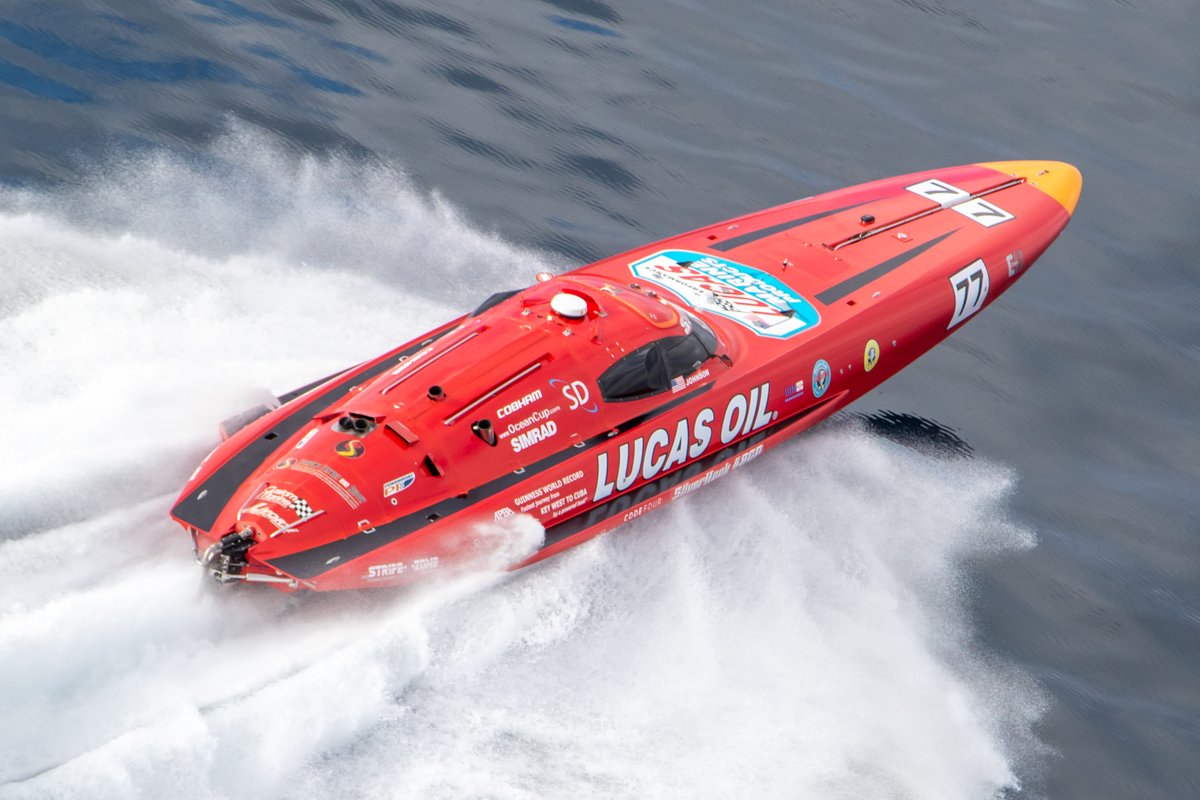
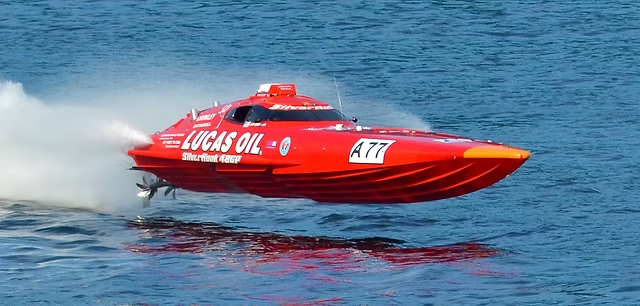
On October 1, 2021, Nigel Hook and Jay Johnson piloted a Lucas Oil/E3 Batteries sponsored Mystic C5000 catamaran around Catalina Island in 1 hour and 10 seconds.
The vessel, classified at 44 feet 9 inches under UIM regulations for the 45-foot class, was powered by twin Mercury Racing 1550 engines producing over 3,100 combined horsepower. The run was part of the Second Annual Ocean Cup Race held during the Pacific Airshow at Huntington Beach.
The 1:00:10 was set on Sunoco Supreme 112 — a leaded race fuel containing Tetraethyl Lead (CAS 78-00-2) at 0.18-0.27% by weight. CG does not certify records set on leaded fuel. This record is recognized as a UIM-sanctioned time but is open for CG purposes.
Read our full policy on leaded fuel →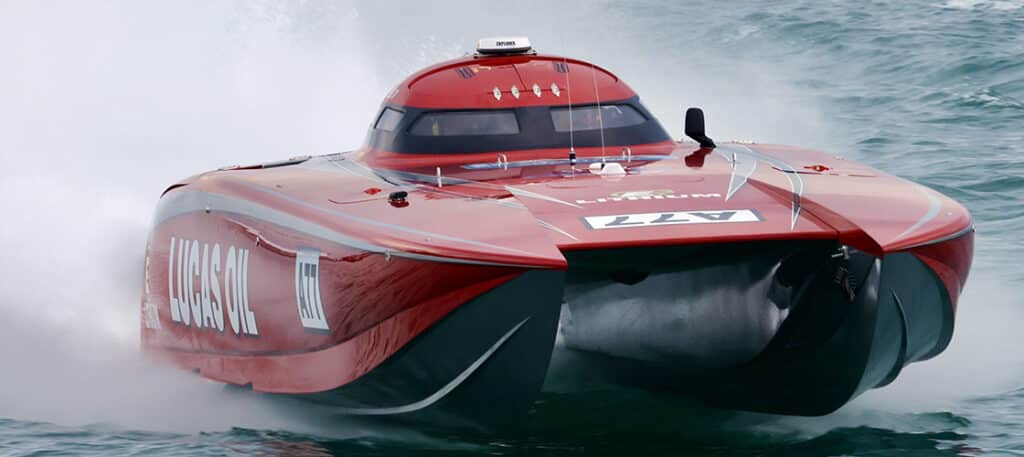
The Previous Record
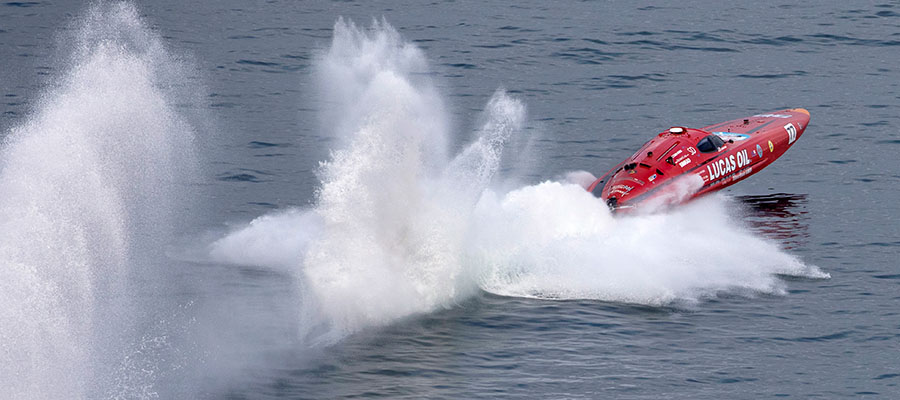
Hook and Johnson held the previous record in a SilverHook 48GP V-bottom at 1:19:28 (84.94 mph average), set during the First Annual Ocean Cup in October 2020. Upgrading from the V-bottom to the Mystic C5000 catamaran made a 33% improvement in average speed — dropping nearly 20 minutes off the time.
| Date | Time | Avg Speed | Vessel | Hull | Fuel |
|---|---|---|---|---|---|
| October 2020 | 84.94 mph | Lucas Oil 77 / SilverHook 48GP | V-bottom | Leaded | |
| October 2021 | 112.90 mph | Lucas Oil/E3 Batteries A77 / Mystic C5000 | Catamaran | Leaded |
Platform Matters: The switch from V-bottom to catamaran gained 28 mph in average speed. The catamaran's superior lift-to-drag ratio and twin-hull stability proved decisive on Southern California waters. Same driver, same throttleman, same sponsor — the platform was the variable.
How to Break This Record
The sub-hour barrier is 10 seconds away. That is a 0.17% improvement over the current record. At 112 mph, 10 seconds equals roughly 0.31 miles — about 1,640 feet.
Current record: 1:00:10 (112.90 mph avg)
Target time: 59 minutes, 59 seconds
Required average: 112.03 mph
Improvement needed: 10 seconds / 0.17%
Where the Time Is
| Category | Upgrade | What It Does | Est. Time Saved | Feasibility |
|---|---|---|---|---|
| Conditions | Calmer day | Less throttle-back through southern point and backside chop | 10-30 sec | Weather |
| Optimized course line | Sub-meter GPS waypoints — 0.1 mi saved = 3.2 sec at 112 mph | 5-15 sec | Achievable | |
| Power | Mercury Racing 1650 swap | +100 hp/engine (3,300 hp total), same QC4v block | 5-15 sec | Bolt-on |
| Mercury Racing 1750 swap | +200 hp/engine (3,500 hp total), larger turbos — must retune for E85 (factory 117 MON is leaded) | 15-30 sec | Competition | |
| E85 / methanol fuel | Higher octane + charge cooling = 10-25% more power. Fuel system rebuild + ECU retune | 10-30 sec | Fuel rebuild | |
| ECU retune / MoTeC swap | Aftermarket MoTeC M150 for QC4v — knock control, custom boost maps, drive-by-wire | 3-8 sec | Specialized | |
| Aero | Cockpit relocation — crew into hulls | Split crew one per hull, sit lower in the boat. Removes ~1.08 m² (11.6 ft²) of frontal area from the wind. Frees the freeboard tunnel for fairing. ~3.8% of total aero drag. | 30-40 sec | Hull modification |
| Satellite dome → flush antenna | ~12" hemisphere on canopy top. 0.13% of aero drag, ~14 lbf at 130 mph. Replace with low-profile unit. | ~1 sec | Easy | |
| Mirror → flush camera | Side mirror + arm. 0.18% of aero drag, ~19 lbf at 130 mph. Swap for waterproof cam + cockpit display. | ~2 sec | Easy | |
| Controls | Automated throttle / traction control | Computer monitors RPM spikes when hull goes airborne, soft-limits revs, reapplies on reentry — 10ms vs 200ms human reaction | 5-15 sec | Available |
The Power Ladder
Mercury Racing builds the QC4v platform in seven models from 860 to 1,750 hp — all sharing the same 9.0-liter V8 block. The record was set on the 1550/1350 dual-calibration model. Two steps up are available without changing the drivetrain:
| Engine | Power | Fuel | RPM Range | Twin Total HP |
|---|---|---|---|---|
| 1550 (current) | 1,550 hp | 112 AKI race gas — leaded (~$25/gal) | 6,200-6,800 | 3,100 |
| 1650 | 1,650 hp | Race gas — leaded, similar to 1550 | 6,200-6,800 | 3,300 |
| 1750 | 1,750 hp | 117 MON — leaded race fuel (see note below) | 6,500-6,800 | 3,500 |
All QC4v engines are twin-turbocharged with seawater-cooled intercooling (air-to-water charge air cooler). Boost is electronically managed by Mercury's Propulsion Control Module (PCM) — it continuously adjusts turbo boost and provides individual cylinder fuel and spark control. Mercury does not publish exact boost PSI or turbo compressor sizes; these are proprietary. What is known: the 1750 uses larger compressor wheels than the 1550/1650, with pulse-separated exhaust tuning to keep turbos spooled and eliminate lag. Compression ratio across the family is 7.8:1 — low, because the turbos do the work.
The 1750 is Mercury Racing's most powerful engine — top of the QC4v lineup. 2,000 ft-lbs of peak torque. Comes standard with a surface-piercing M8 drive. At 660 lbs stripped (900+ lbs dressed), weight is comparable to the 1550. Same block, same mounts, same architecture.
This is not just a 1750 issue. The existing Catalina record was set on leaded fuel. The Mercury Racing 1550 runs on 112 AKI race gas — Sunoco Supreme 112, which is leaded. Sunoco does not make an unleaded race fuel above 104 octane. The 1650 uses the same fuel. The 1750 runs on 117 MON — also leaded. Every QC4v engine above 1,350 hp runs on leaded gasoline from the factory.
Chasing Greatness will not certify any record set on leaded gasoline. Lead is a neurotoxin. We are running these boats over open ocean, through marine ecosystems, past kelp forests and protected areas. Dumping lead exhaust into the Pacific is a hard line for us — same as chopping through kelp beds or running through MPAs. We love pushing the rules on speed. Environmental damage is not a rule we push.
The solution is E85 — for any engine in the lineup. E85 is unleaded, provides 105-113 AKI octane (enough for any QC4v calibration), and on turbocharged engines typically makes more power than the leaded fuel it replaces. A CG-certified Catalina record will be set on unleaded fuel or it will not be set at all.
Fuel explained: "AKI" is the octane rating at the gas pump — regular is 87, premium is 91-93. Race gas starts around 100 AKI. Sunoco's unleaded race fuels top out at 104 AKI. Above that, all standard race fuels are leaded — including the 112 AKI Sunoco Supreme that the 1550 runs on and the 117 MON fuel spec'd for the 1750. "MON" is a different octane scale (motor octane number) — 117 MON is roughly equivalent to 120+ AKI. E85 is 85% ethanol (grain alcohol) mixed with 15% gasoline, available at some gas stations for ~$3/gallon, with an octane rating around 105-113 AKI — unleaded. This makes E85 the highest-octane unleaded fuel readily available, and on turbocharged engines the charge cooling effect means it typically outperforms the leaded fuel it replaces. Methanol is pure wood alcohol — even higher octane (~116 AKI), better cooling properties, also unleaded, but requires a complete fuel system rebuild because it is more corrosive and the engine burns roughly 2x the volume.
The play is E85 on whatever engine you run. Whether it is the 1550 or the 1750, the conversion is the same: swap the factory leaded calibration for an E85 tune on a MoTeC M150 ECU, upgrade fuel injectors, pump, and lines to flow 30-36% more volume, and run. E85 has comparable octane to leaded race gas but dramatically better charge cooling — the ethanol absorbs heat as it vaporizes, creating a denser intake charge. On turbocharged engines, E85 commonly produces 10-20% more power than gasoline at the same boost levels. On a 1750 making 3,500 hp total on leaded race gas, an E85 tune could match or exceed that power on unleaded fuel. For a single 60-minute run the corrosion concerns are negligible. No lead. More power. Less money on fuel.
Extracting More: Fuel, Ignition, and Forced Induction
For a one-hour sprint, reliability margins can be pushed harder than in endurance racing. The QC4v block can handle more than the factory calibration delivers:
| Modification | How It Works | Estimated Gain | Risk / Rule Status |
|---|---|---|---|
| E85 ethanol conversion | ~105-113 AKI octane (vs 112 AKI race gas). Massive charge cooling effect — ethanol absorbs heat as it vaporizes, creating denser intake charge. On boosted engines, E85 commonly gains 5-20% power over gasoline. Requires 30-36% more fuel volume (larger injectors, pump, lines) and ECU recalibration. Ethanol is hygroscopic (attracts water) — a concern in marine environments but manageable for a single sprint. | 10-20% power | Proven in turbo apps |
| Methanol fuel blend | Even higher octane than E85 (~116 AKI). Superior cooling properties, denser energy. Same fuel system rebuild as E85 but with even larger volume requirements. More corrosive than ethanol — seals, lines, and injectors all need upgrading. | 15-25% power | Fuel system rebuild |
| Advanced ignition timing | MoTeC M150 ECU replaces factory unit. Adds knock control, per-cylinder timing maps, and custom boost profiles. Allows running closer to detonation threshold safely. | 3-5% power | MoTeC M150 available |
| Increased boost / larger turbos | The 1750 already uses larger compressor wheels. Custom turbos beyond 1750 spec could push 1,900+ hp but risk exceeding engine tolerances. | 5-10% power | Engine risk |
| Water/methanol injection | Intercooler supplement — cools charge air, reduces knock tendency, allows more boost. Common in turbo applications. Can run continuously. | 5-8% power | Common in turbo apps |
Throttle Automation: Offshore Traction Control
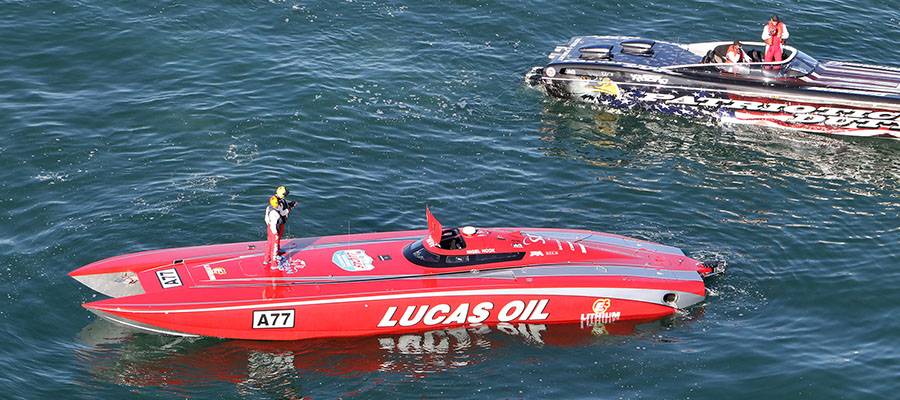
Mercury's Digital Throttle and Shift (DTS) comes standard on every QC4v engine — including the 1550 that set the record. DTS replaces mechanical throttle cables with digital drive-by-wire, providing automatic throttle synchronization between the twin engines and shadow mode (one lever controls both). It is already on the boat. It was used during the record run. DTS is throttle-by-wire — it makes the throttleman's inputs more precise, but it does not make decisions for him.
What DTS does not do is traction control. At 112+ mph, the hull leaves the water constantly. When it does, the engines over-rev in the air and then shock-load the drivetrain on reentry. The throttleman manages this manually — backing off before a jump, reapplying after landing. Human reaction time is 200-300 milliseconds. A computer can respond in under 10.
The concept is identical to motorcycle traction control: an RPM monitor detects sudden spikes (indicating the hull has left the water), a soft rev limiter holds RPM steady through the jump, and power is reapplied progressively on reentry rather than slamming full load into the drivetrain.
The hardware already exists. DTS provides the drive-by-wire interface — the computer already controls the throttle electronically. The MoTeC M150 ECU (available as a plug-in replacement for the factory QC4v PCM) adds the logic layer: knock control, per-cylinder timing, and the I/O for RPM-based throttle intervention. The Victory offshore racing team built exactly this kind of system — monitoring throttle, trim, slip, and steering input to assist the throttleman. The add is a software calibration on top of hardware the boat already has, not a new system.
Even a partial implementation — one that only manages the air-to-water reentry transition — could save 5-15 seconds over 112 miles. The throttleman keeps control of overall speed, trim, and course management. The computer just smooths the transitions faster than human reaction allows.
Aero: The Big Idea and the Small Stuff
The small stuff first: the satellite dome (~12" hemisphere, 0.76 ft² frontal area, Cd 0.42) produces about 14 lbf of drag at 130 mph. The side mirror and arm (~0.38 ft², Cd 1.17) produces about 19 lbf. Combined they account for 0.31% of total aerodynamic drag — roughly 3 seconds over the hour. Worth doing, but marginal.
The bigger idea: the current cockpit puts driver and throttleman side by side on the freeboard between the hulls. Both crew members' torsos and helmets are exposed to 130 mph airflow — roughly 1.08 m² (11.6 ft²) of frontal area with a Cd around 0.8. That is 3.8% of total aero drag, worth an estimated 30-40 seconds over the course.
What if you split them — one crew member in each hull, seated lower? Each person drops below the hull profile. The freeboard between the hulls can then be faired smooth or lowered entirely, turning what is currently a drag surface into a clean tunnel. The aero penalty of having two humans in the wind goes to near zero. The trade-off is crew communication (solvable with radio/intercom, which they already use) and the structural modification to create cockpit cutouts in each hull. For a dedicated record attempt, that modification is worth the 30-40 seconds it buys.
Target time: 55 minutes flat
Required average: 122.2 mph
How to get there: 1750 swap (+13% power) + calmer day + course optimization
The Physics of 112+ MPH
At speeds above 100 mph on water, the hull is airborne roughly 85% of the time. The physics shift from hydrodynamics to aerodynamics.
The Catamaran Advantage
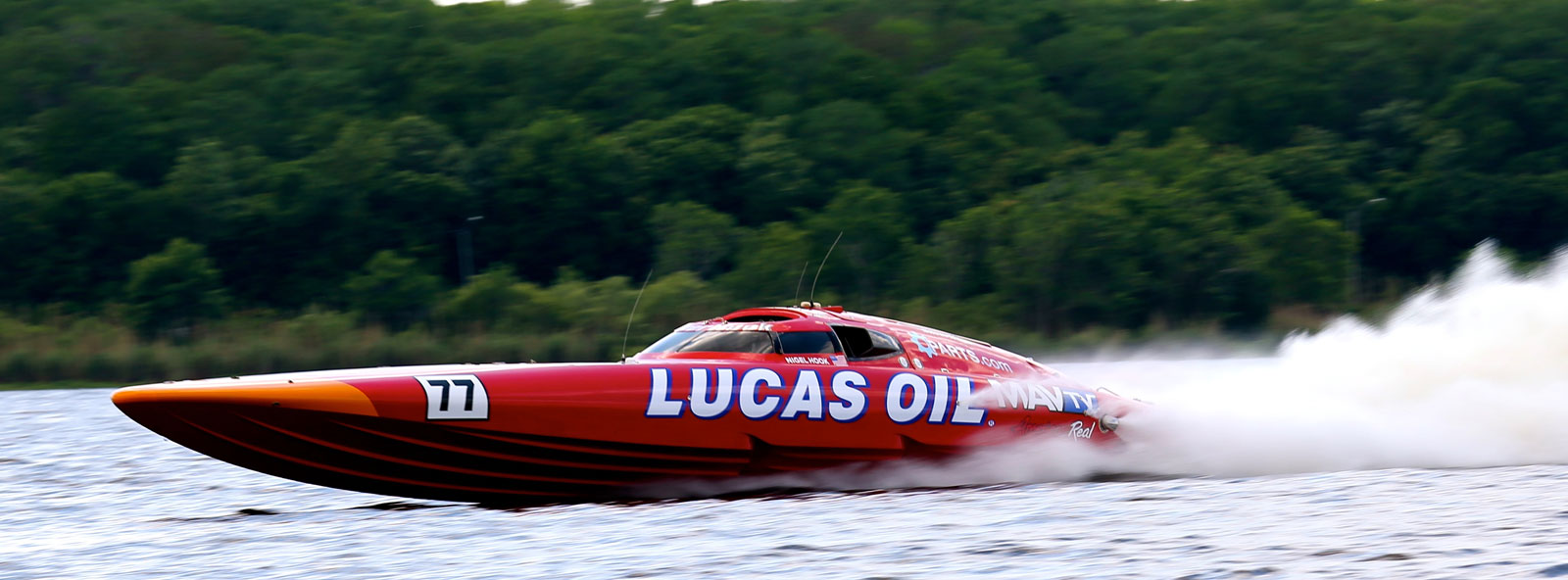
The switch from V-bottom to catamaran gave Hook/Johnson a 28 mph improvement in average speed. Catamarans dominate at these speeds for several reasons:
- Twin hulls trap air between them, creating aerodynamic lift that reduces wetted surface
- Less wetted surface area means less hydrodynamic drag at speed
- Wider stance provides stability during acceleration and high-speed turns
- Stepped hulls break suction, further reducing drag — a "blown" step design actively channels air under the hull to lift it further off the water
- Weight distributed across two hulls allows larger fuel loads without compromising performance
Power Requirements
The Mystic C5000 runs twin Mercury Racing 1550 engines — 3,100+ horsepower total. At sustained speeds above 110 mph, this is not overkill.
Hydrodynamic drag: ~400 hp
Propulsion losses: ~300 hp
Total power demand: ~2,900 hp at cruise
Available power: 3,100 hp
Reserve margin: ~7%
With only 7% power reserve at cruise, there is minimal headroom for acceleration or fighting adverse conditions. A 15-knot headwind can consume the entire reserve and force the boat to slow. This is why conditions matter as much as equipment.
Course Conditions
The Ocean Cup course starts at Huntington Beach Pier, heads to Ship Rock, circles Catalina Island, and returns to Huntington Beach. Conditions vary dramatically around the course.
Critical Sections
| Section | Typical Conditions | Speed Impact |
|---|---|---|
| Huntington to Ship Rock | Generally calm, protected | Full speed |
| Ship Rock to North Island | Open water, building swells | 90-100% |
| Catalina Backside | Exposed to Pacific swells | 80-95% |
| Southern Point | Wind acceleration zone | 70-90% |
| Return to Huntington | Typically calmer | Full speed |
Weather Patterns
The Ocean Cup is held during the Pacific Airshow in October. October offers the most consistent calm conditions in Southern California waters — summer's marine layer and thermal winds have subsided, fall storms have not yet arrived.
October Advantage: The Pacific is at its calmest. Water temperatures are warm from summer heating, reducing kelp density around the island. The airshow draws spectators and media, making it the ideal venue for record attempts.
Hazards
Catalina is surrounded by giant bladder kelp (Macrocystis pyrifera) — the largest and fastest-growing algae species, growing up to two feet per day. The kelp grows in shallow water (generally under 130 feet depth), meaning it concentrates close to shore around the island. At 110+ mph, hitting a kelp mat can stop a boat violently or foul props.
The course naturally routes well offshore of the kelp line except at the island's points where the continental shelf extends further out. October timing helps: warmer summer water temperatures reduce kelp density, and in some years storms have cleared large sections entirely. Local knowledge of clean corridors is essential for pre-mapping the GPS course line.
CG position: Kelp forests are a hard line. We will not certify any record attempt that routes through kelp beds. The course line must clear all kelp zones with margin. Catalina's kelp forests are already under pressure from warming ocean temperatures and storm damage — a 3,500 hp catamaran shredding through at 130 mph is not something we will put our name on. Route around it or don't run.
.%20Image%20created%20by%20CDFW%20GIS%20lab.jpg)
The southern tip of Catalina accelerates prevailing winds. Even on calm days, 20-25 mph winds are common at the point, creating chop where calm water meets disturbed water. This is where many runs lose the most time.
The San Pedro Channel is one of the busiest shipping lanes in North America. The Ocean Cup establishes a Coast Guard safety zone, but awareness of commercial traffic is essential for any attempt outside of the sanctioned event.
Equipment Deep Dive
Breaking the Catalina record requires equipment at the absolute cutting edge of marine performance.
The Record-Holding Platform
The benchmark offshore racing catamaran. Carbon fiber construction, optimized tunnel design, and proven 160+ mph capability. The only platform that has gone sub-1:01 around Catalina.
View SpecificationsPower Systems
The highest-output production marine engine available. Designed for offshore racing catamarans. The record was set on this engine.
View SpecificationsFor class records or longer endurance formats, the 1350 offers serious power with better fuel margins. Competitive in the 45-foot class where the C5000 runs.
View Specifications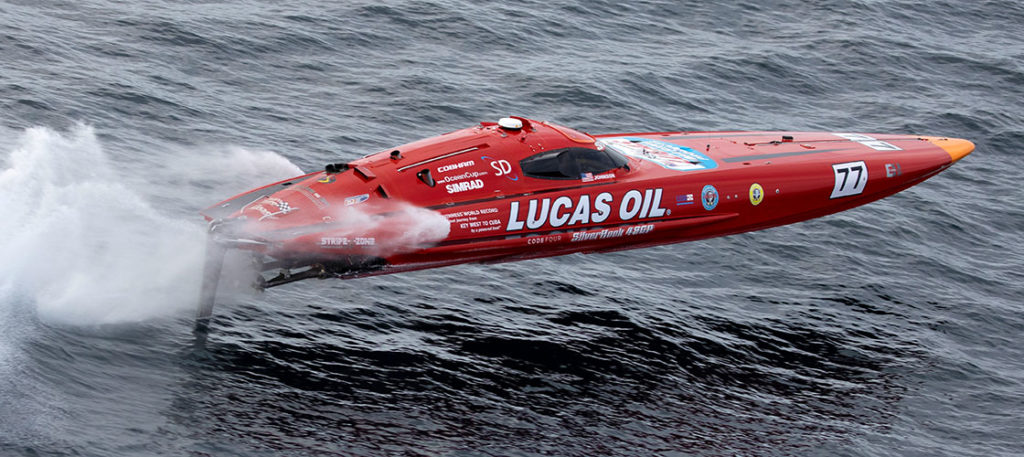
Safety Equipment
At 145 mph, any impact is violent. UIM-spec required for sanctioned events. Keeps crew in position during extreme G-forces and provides survival restraint in a rollover.
View OptionsRequired for all sanctioned offshore racing. Impact protection, face shield for spray, and integrated radio between driver and throttleman.
Check PriceElectronics
At 112 mph, a 10-foot course deviation costs fractions of a second. Pre-mapped optimal lines displayed in real-time help the driver maintain the shortest path around the island.
View OptionsClass Opportunities
The Ocean Cup recognizes multiple classes based on boat length. While the 45-foot class gets the headlines, other classes offer record opportunities.
Current Class Records
| Class | Time | Average Speed | Holder |
|---|---|---|---|
| 45-Foot Class (Unlimited) | 112.90 mph | Hook/Johnson | |
| 30-50 Foot Class (V-bottom) | 1:19:28 | 84.94 mph | Hook/Johnson |
| 30-Foot and Under | 1:57:40 | 57.37 mph | Bauman/Reindl |
The 30-Foot Class Opportunity
Underexplored Category: The 30-foot and under record stands at just under 2 hours — nearly double the unlimited time. Modern 30-foot catamarans with quad 450R outboards can sustain 90+ mph. Breaking 1:30:00 in this class (75 mph average) should be achievable with the right equipment.
Target time: 1:30:00
Required average: 74.67 mph
Improvement needed: +30% over current record
Modern 30-foot performance cats regularly run 85-95 mph. The current record appears soft. A well-prepared 30-foot cat could break 1:20:00 in optimal conditions.
Potential New Classes
As powerboat technology evolves, new class opportunities may emerge:
- Electric/Hybrid Class — as battery technology improves, an electric circumnavigation becomes feasible
- Outboard-Only Class — separating outboard-powered boats from inboard racing engines
- Production Class — stock or near-stock production boats for manufacturer participation
- Single-Engine Class — testing efficiency and skill over raw power
Nigel Hook is not just the record holder — he founded the Ocean Cup Series in 2013. He built this event into the premier powerboat record venue on the West Coast. After 22 years of partnership, Hook and Lucas Oil parted ways in late 2022. Hook continued racing the Mystic C5000 under the Ocean Cup banner, and in 2024 teamed up with off-road racer Roger Norman in a rebranded #47 Mystic for the Gateway Marathon. He knows this course better than anyone alive. Breaking his record means beating the man who designed the challenge.
The Around Catalina record remains one of the most prestigious achievements in American powerboat racing. The one-hour barrier is 10 seconds away. The course is defined. The standards are UIM-sanctioned. The question is who will claim the next line in the record book.